Remove repeated handling
Move information between the right tools without asking someone to retype it at every step.
Automation & AI / Workflows · Integrations · Control
Turn a repeated manual process into a dependable workflow. Start with one operational problem, connect the right tools and give your team a clear way to manage exceptions.
From £2,495 · Founder-led · UK-wide
Illustrative workflow / Enquiry handling
Illustrative workflow / Enquiry handling
The useful starting point is a real sequence: what triggers it, where information moves, and what happens when something is missing.
A real event starts the workflow — not a vague ambition to use AI.
Incomplete or repeated events wait for a person before anything downstream runs.
The routine work moves. Exceptions stay visible instead of disappearing into a queue.
Automation work draws on experience designing operational systems where workflow state, permissions, case management and reporting all need to work together.
The opportunity
The useful starting point is a real process: what triggers it, where information moves and what happens when something is missing. We map the routine work and the awkward cases before choosing an integration or introducing AI.
Leads sit in inboxes. Quotes get retyped. Reminders are forgotten. Reports are built by hand every week.
Move information between the right tools without asking someone to retype it at every step.
Set approval points and exception queues wherever human judgement or review is important.
Plan validation, retries and alerts so a broken integration is discoverable and recoverable.
What’s included
The proposal defines the exact deliverables. These are the areas we bring together, with responsibilities and dependencies agreed before work begins.
01
Document the trigger, source of truth, required fields and handoffs. Include edge cases, ownership and the manual fallback for the scoped process.
02
Connect agreed APIs, forms, CRM or booking tools. Define field mapping, access permissions and how repeated or incomplete events are handled.
03
Use AI for suitable tasks such as classification or drafting, with reviewed examples, bounded inputs and human checks where errors matter. Deterministic rules handle predictable decisions.
04
Test normal paths and failures, document credentials ownership and provide an operating guide. Monitoring and future changes have an explicit support arrangement.
At a glance
Engineering judgement
A workflow that only handles the happy path can create more admin than it removes. Reliability is part of the scope, not an extra polish step.
Missing data: flag it for review before an action depends on it.
Repeated events: prevent duplicate records, messages or downstream actions.
A tool goes offline: log the problem, retry safely and give a person a way to intervene.
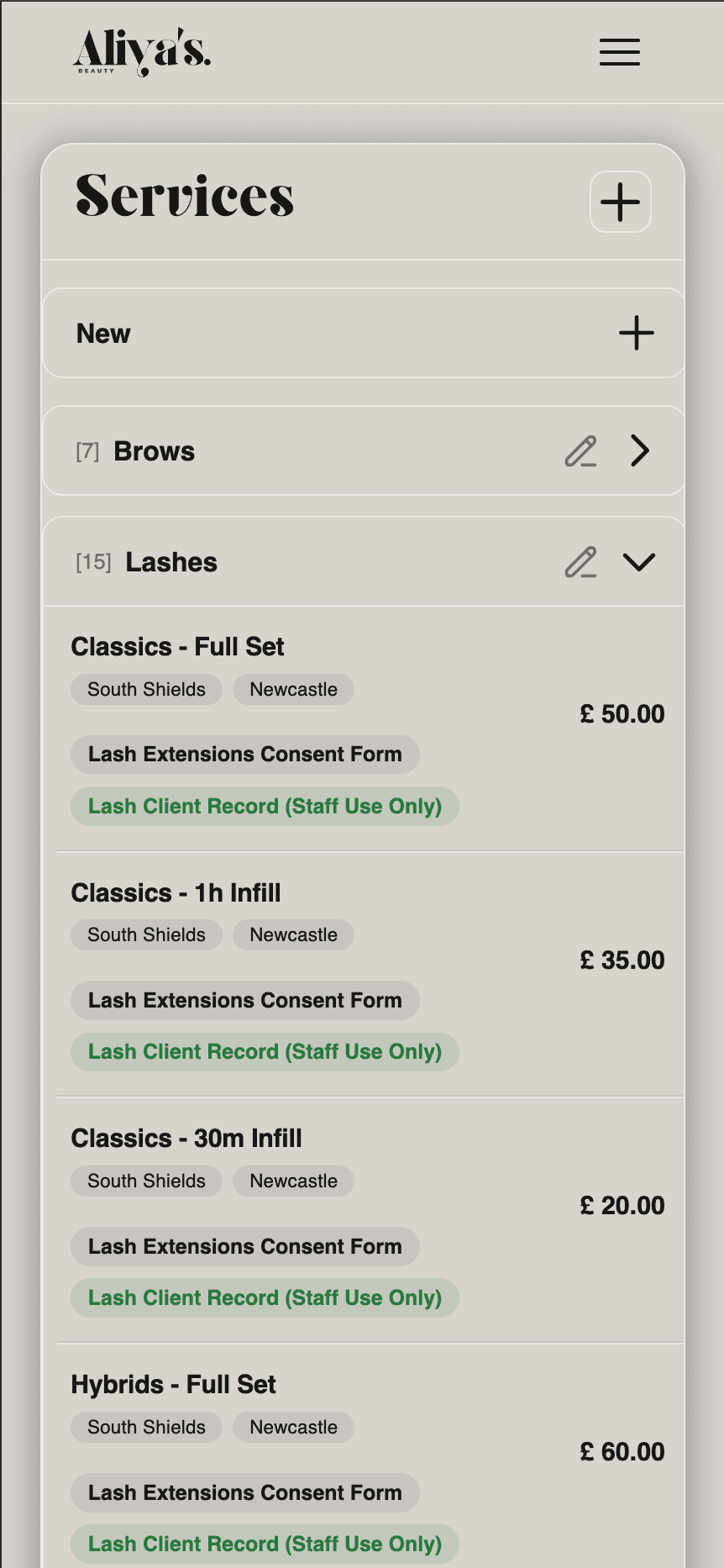
Related client work / Connected booking operations
Aliya’s Beauty brings appointments, deposits, treatments and staff availability into the same operational picture. It shows how customer actions connect to the work behind the website; it is not presented as an AI implementation.
Explore Aliya's BeautyDelivery
You see progress at agreed checkpoints. Each stage has decisions, responsibilities and a concrete next step, so the project stays understandable.
Nasim leads the work and remains your point of accountability. Specialist involvement, review points and any changes to scope are agreed with you.
Pricing & scope
Starting prices give you a useful reference. The written proposal confirms what is included, what you need to supply and any ongoing costs.
Project
From £2,495
Typical range: £2,500–£5,000
One clearly scoped operational automation problem.
Discuss automation sprintAn Automation Sprint starts at £2,495, typically £2,500–£5,000 for one defined process. Third-party subscriptions, API usage and ongoing monitoring are separate where required. Wider operational systems are scoped as software development.
Is it the right fit?
If a smaller change, an existing product or a different service is a better starting point, we’ll explain why.
Connected services
Choose the next investment around the business need. These services connect naturally without being compulsory additions.
Questions
Scope, practicalities and the decisions worth making early.
Often no — many sprints connect existing tools. Larger workflow needs may move to software development.
No. Predictable rules and standard integrations are often more suitable. AI is useful where the task involves varied language or unstructured information and there is a practical way to assess the output.
Usually, if they offer suitable APIs, exports or supported integrations. We check access, usage limits and data ownership before committing to a scope. Where a tool cannot support a dependable integration, we explain the alternatives.
We agree logging, alerting, retry behaviour and a manual fallback for the workflow. Monitoring ownership and response expectations are covered in the handover and any ongoing support agreement.
We map what data is needed, which systems receive it and who can access it. Data minimisation, permissions and retention are discussed during scoping. Using an AI provider requires an explicit review of whether the proposed data flow is suitable.
Let’s make it work
Describe the process, the people using it and where the current tools stop helping. We’ll discuss fit and the right level of discovery before you commit to a build.
An initial conversation is free. Scope and costs come before a commitment.